Oct 26, 2026
The real estate photography industry has evolved rapidly over the past decade. What was once a solo craft centered almost entirely around camera gear and late-night desktop retouching is now shaped by AI-assisted tools, workflow automation, and scalable post-production systems. Today, real estate photographers are expected to deliver next-morning galleries, handle larger seasonal workloads, and maintain uniform visual standards across every listing.
As client expectations accelerate, one strategic question stands out for studio owners: Where does automated AI help—and where do human editors remain irreplaceable in real estate photo editing? The answer lies at the intersection of AI pre-processing, operational automation, and human quality control.
Residential and commercial property marketing operates on compressed timelines. Agents, brokers, and builders need listing assets live on the MLS within hours of the shoot, and sellers expect immediate marketing momentum. As a result, photographers face constant pressure to shorten turnaround times without compromising architectural accuracy.
A decade ago, a 48- to 72-hour delivery window was routine. Today, top-producing real estate teams expect next-morning delivery by 8:00 AM—and same-day twilight or hero frames on flagship listings.
The challenge is no longer simply capturing sharp brackets on site. The challenge is running a production pipeline capable of delivering clean, color-accurate galleries overnight at scale.
Artificial intelligence has reshaped raw pre-processing across creative workflows. Using modern Adobe Lightroom AI masking tools and specialized neural plugins, editors can accelerate initial passes on:
Tasks that once required repetitive preliminary selections can now be initialized in seconds. Yet studio tests quickly reveal the boundary between raw pre-processing and finished commercial delivery.
AI does not replace architectural judgment—it accelerates repetitive prep work while leaving complex optical decisions to trained specialists.
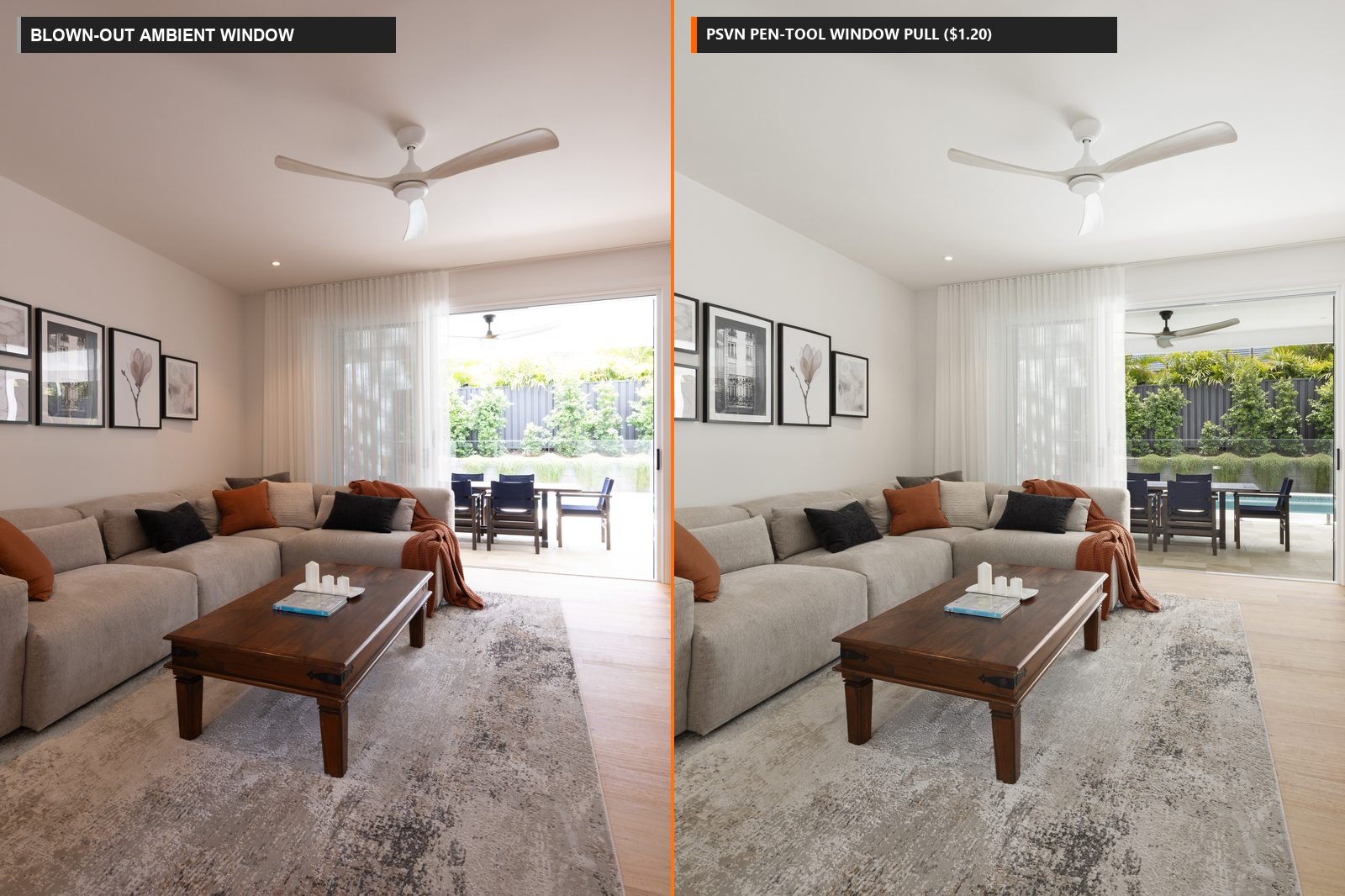
Real estate photography must represent physical spaces truthfully under MLS rules while handling mixed Kelvin lighting, glass reflections, plantation shutters, and fine cabinetry textures. Automated batch apps guess at pixel patterns; experienced human retouchers understand room geometry and light direction.
Studios that pair smart workflow automation with skilled human retouchers gain speed without shipping plastic-looking HDR artifacts to their clients.
Beyond pixel retouching, operational automation transforms how growing photography studios manage daily volume. High-performing real estate media companies automate:
The objective is straightforward: eliminate administrative friction between the camera card and client delivery.
Every hour spent renaming files, chasing status updates, or fixing inconsistent exports steals capacity from shooting and client acquisition. Reliable operational systems build predictable morning delivery—and predictability builds long-term brokerage retention.
The most profitable shift in modern property media is transitioning from solo manual effort to a documented overnight post-production workflow. Historically, a single photographer shot the listing, blended the brackets at night, answered emails, and exported the gallery.
While that solo loop works at two or three shoots a week, it breaks down rapidly once volume scales. Bottlenecks multiply, turnaround times slip, and associate photographers introduce mismatched color styles.
A structured production system decouples on-site shooting from overnight editing. The fastest-growing real estate media studios win market share not simply because they own newer camera bodies, but because their back-end production pipeline delivers uniform quality every morning.
As mirrorless sensors, strobes, and editing software improve across the board, occasional hero shots are no longer enough to differentiate a studio. What top-producing realtors actually pay for is gallery-wide consistency across dozens of listings per year.
Can an agent trust that Tuesday’s rainy-day condo shoot will look just as clean and neutral as Friday’s luxury estate? Understanding the workflow behind every consistently delivered image shows why repeatable execution turns one-off shoot bookings into multi-year brokerage retainers.
Even with rapid advances in machine learning, human retouching expertise remains the backbone of professional real estate photo editing. Automated algorithms cannot reliably replace:
For a side-by-side visual breakdown of where batch software breaks down on real brackets, review our AI vs. human hand-blending quality benchmark.
Forward-looking studio owners evaluate their post-production stack around four operational questions:
Across North America, Australia, and Europe, PSVN partners with photography studios to solve these exact scaling challenges—combining fast cloud intake with dedicated human editing pods and multi-stage quality assurance.
Five clear operational trends are defining the next chapter of real estate media production:
Smart masking and RAW organization tools will handle initial prep work inside professional editing suites rather than operating as unchecked one-click replacements.
Next-morning gallery delivery will remain the non-negotiable standard for competitive residential brokerages.
Studios will bundle stills, 2D/3D floor plans, virtual staging, and vertical social reels from a single on-site appointment.
Winning workflows will pair efficient intake automation with human Photoshop craftsmanship and senior human inspection.
As entry-level tools proliferate, studios that guarantee zero-defect galleries and punctual delivery will command premium pricing.
| Quality & Workflow Factor | 100% Automated AI Editing Apps | PSVN Human Editors + 2-Layer Senior QC |
|---|---|---|
| Complex Window Pulls (Blinds / Trees) | Leaves grey halos or plastic edges around mullions | Hand-masked pen & luminosity cuts in Photoshop |
| Mirror & Flash Reflection Removal | Struggles with specular glare and warps background tiles | Clean manual clone & perspective reconstruction |
| Multi-Room Color Cohesion | Grades each photo in isolation (white balance drift) | Layer-2 QC Survey Mode matches the entire 40-photo gallery |
| Cost per Edited Photo (USD / AUD / GBP) | Cloud AI apps ($0.45–$0.65 USD/photo) + morning re-edits | $0.60–$1.20 USD · A$0.90–A$1.80 AUD · £0.50–£0.95 GBP (client-ready) |
The future of real estate photography belongs to studios that combine creative on-site shooting with disciplined, scalable post-production systems.
At PSVN, our 80+ editing specialists and 2-Layer Quality Control team give real estate photographers the best of both worlds: effortless overnight workflow speed paired with true human hand-blending precision. While software tools will continue to evolve, realtor demand for natural window pulls, accurate color, and dependable morning delivery remains constant.
While AI speeds up basic RAW pre-processing, automated batch tools still struggle with complex Flambient flash shadows, plantation shutter window pulls, mirror reflection removal, and multi-room color consistency—which is why professional studios rely on PSVN’s 80+ human specialists and 2-Layer QC.
PSVN’s human-edited, 2-Layer QC inspected photos start at $0.60 USD (Basic single exposure) and $1.20 USD (Standard HDR/Flambient)—delivering client-ready files in 12 hours overnight so you spend zero morning hours fixing artifacts.
Yes. Every 3D virtual staging ($9.00–$26.00 USD) and item removal ($1.00–$14.00 USD) order is completed and inspected by experienced architectural 3D artists and senior retouchers for accurate perspective and MLS compliance.
Ready to scale your studio with overnight 12-hour post-production? Start your Free Trial with PSVN today (3 RAW photo sets + 1 video clip edited free, plus 10% off your first month).
Related Editorial Guides
View All Guides