
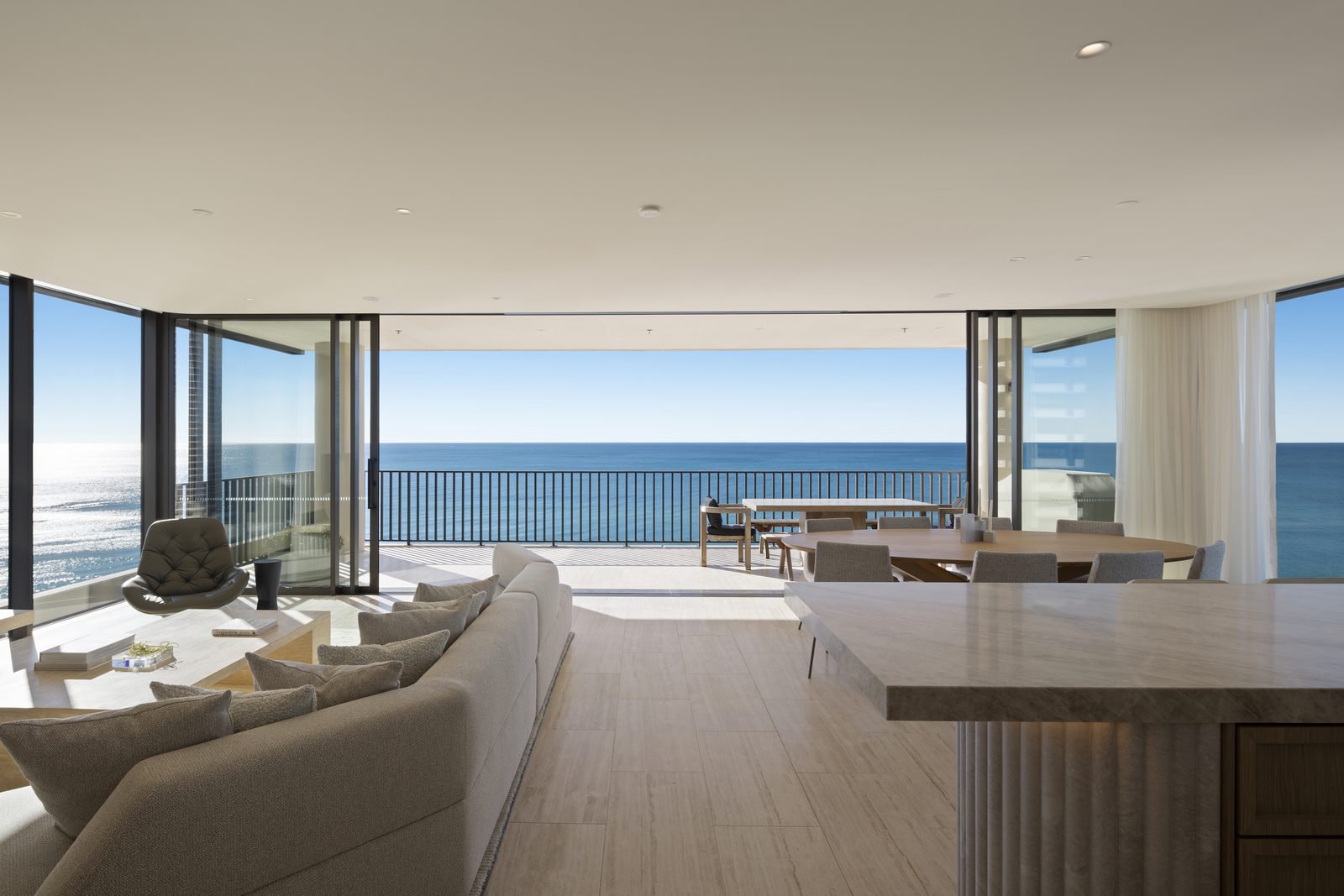
HDR Bracketing vs. Hand-Blended Flambient in Real Estate Photography: Speed, Cost & MLS Results
Choosing between hdr vs flambient real estate photography comes down to a trade-off between on-site shooting speed and interior colour accuracy. Multi-bracket HDR (3 to 5 ambient exposures) lets you shoot a 2,500 sq ft home in 30 minutes, while hand-blended Flambient (ambient brackets plus flash frames) takes 45 to 60 minutes to eliminate mixed lighting colour casts and produce crisp window pulls. When outsourced to PSVN’s real estate photo editing service, both HDR and Flambient brackets are hand-blended at the same studio rate of $0.75 to $0.85 USD per finished image with a 12-hour turnaround.
By Khanh Tran & PSVN Post-Production QC Team · Updated October 22, 2026
HDR vs Flambient Real Estate Photography: What Is the Core Difference?
The fundamental difference between HDR bracketing and Flambient photography lies in how light is recorded inside the room before post-production begins. Standard HDR relies exclusively on available ambient light captured across multiple shutter speeds, while Flambient introduces a controlled burst of 5500K–5600K flash to record the true colour of walls, ceilings, and cabinetry.
In an HDR bracketing workflow, the camera stays on a levelled tripod and fires 3 to 5 consecutive exposures spaced 1.5 to 2.0 stops apart (for example, -4 EV, -2 EV, 0 EV, +2 EV, +4 EV). The darkest exposure preserves exterior window views, while the brightest exposures lift deep shadows in hallways and cabinetry. However, when a room has warm 2700K tungsten bulbs mixing with cool 6500K daylight coming through the windows, ambient-only brackets record both colour temperatures on the same surfaces.
In a Flambient (Flash + Ambient) workflow, the photographer captures one well-exposed ambient frame for natural shadow falloff, one or more flash frames bounced into the ceiling to establish accurate white balance, and a darkened flash frame pointed toward the window to freeze the exterior view for a clean Luminosity or Darken mode window pull.
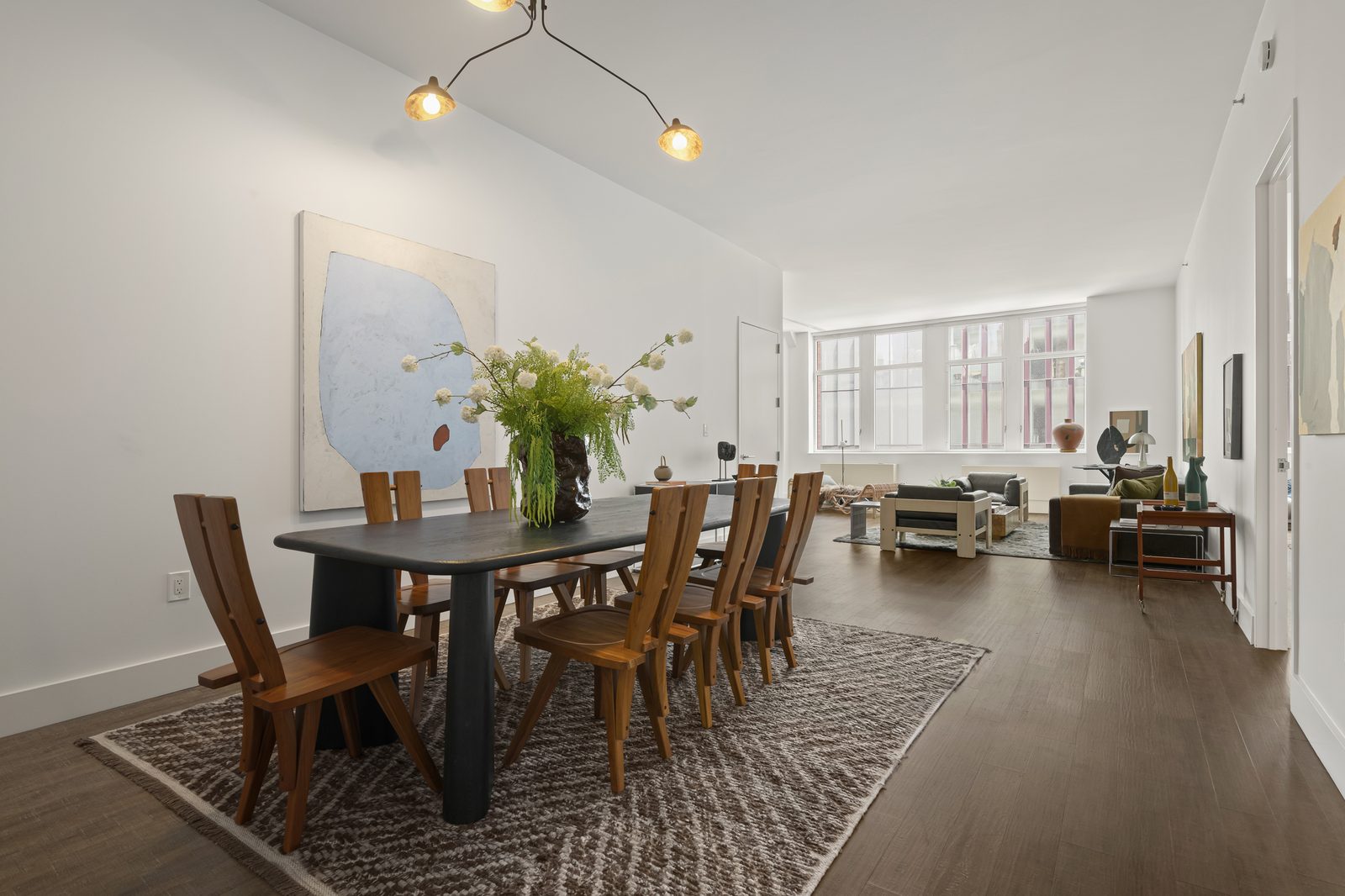
Side-by-Side Comparison: Single Exposure vs. HDR Bracketing vs. Hand-Blended Flambient
To help photography studios and media agencies across the US, Australia, the UK, and Canada standardize their packages, the table below compares our three core editing tiers based on production data from 4,000+ daily property photos processed by PSVN’s 80+ full-time editors:
| Production Metric | Single Exposure Editing | Multi-Bracket HDR (3–5 AEB) | Hand-Blended Flambient (Ambient + Flash) |
|---|---|---|---|
| Input Files per Final Image | 1 RAW or JPG exposure | 3 to 5 ambient RAW brackets (.CR3, .NEF, .ARW, .DNG) | 1–3 ambient frames + 1–2 flash pops + 1 window pull frame |
| Average On-Site Shoot Time (30-Photo Home) | 15–20 minutes | 25–35 minutes | 45–60 minutes |
| Window Pull Clarity | Limited by single-frame dynamic range | Very good (requires manual masking to avoid grey halos) | Studio flagship (crisp Darken/Luminosity window pull) |
| Colour Cast Accuracy | Moderate (single global white balance) | Good after manual colour-cast brushing on walls & ceilings | Exceptional (flash frame locks true paint and wood tones) |
| Specular Reflections (Hardwood & Tiles) | High glare from windows | Moderate window sheen on shiny floors | Minimal glare (flash frame neutralizes window blowouts) |
| PSVN Pricing (USD) | $0.60 / photo | $0.75 – $0.85 / photo | $0.75 – $0.85 / photo |
| PSVN Pricing (AUD / GBP) | A$0.90 · £0.50 / photo | A$1.15 – A$1.30 · £0.65 – £0.70 / photo | A$1.15 – A$1.30 · £0.65 – £0.70 / photo |
| Overnight Turnaround SLA | 12 hours overnight (4–6h Rush available) | 12 hours overnight (4–6h Rush available) | 12 hours overnight (4–6h Rush available) |
When Should Real Estate Photographers Shoot Multi-Bracket HDR?
Multi-bracket HDR is the most profitable shooting method for high-volume residential MLS listings, rental properties, and starter homes where speed on-site directly determines how many shoots a photographer can complete per day. By eliminating light stands and flash recycling times, a single photographer can comfortably shoot 4 to 6 listings per day during peak spring and summer selling seasons.
The reason many photographers hesitate to use HDR is not the shooting method itself—it is the muddy midtones and grey window halos caused by automated tone-mapping plugins like Photomatix or Lightroom Auto-HDR. When HDR brackets are processed manually through layer masking in Photoshop rather than automated tone-mapping algorithms, 90% of standard residential interiors look clean, bright, and natural.
Recommended Camera Settings for Clean HDR Brackets
If you want your input quality for Flambient and HDR editing to yield consistent results overnight, configure your camera bodies with these studio standards:
- Aperture Priority (
Av/AMode) atf/7.1orf/8: Keeps both foreground kitchen islands and background exterior trees sharp without introducing diffraction softness. - Base ISO (
ISO 100toISO 320): Preserves maximum dynamic range in the shadow brackets and prevents chrominance noise when lifting dark timber interiors. - 5-Frame Auto Exposure Bracketing (
AEB) at2.0 EVSteps: Shooting 5 frames at 2 stops apart (-4, -2, 0, +2, +4) guarantees that even bright coastal windows in Australian or Florida listings have a clean-4 EVframe with blue sky detail. - Continuous High Drive + 2-Second Self-Timer (or Electronic Shutter): Fires all 5 brackets in under 1.5 seconds without tripod vibration.
When Does Hand-Blended Flambient Deliver Superior MLS & Luxury Results?
Hand-blended Flambient is essential for architectural listings, luxury properties above $1M, custom kitchen/bath portfolios, and rooms with severe mixed lighting or dark timber panelling. Adding controlled flash solves three physical optical problems that ambient-only HDR cannot fix at the sensor level:
- Mixed Kelvin Colour Casts: In rooms with yellow incandescent chandeliers, orange wood floors, and blue window light, a ceiling-bounced flash frame overpoweringly illuminates surfaces with pure 5500K light. Our editors blend the ambient frame in Luminosity mode at 40%–60% opacity over the flash base layer, preserving natural ambient shadows while retaining 100% accurate paint colours.
- Specular Window Glare on Hardwood Floors: On sunny afternoons, bright windows cast a blown-out white sheen across polished timber or marble floors. A flash pop angled toward the ceiling fills the floor grain with diffuse light, allowing our editors to replace the washed-out floor glare seamlessly.
- Crisp Darken-Mode Window Pulls: Pointing a speedlight or strobe at the window frame at
1/160sor1/200sexposes the exterior view while slightly over-illuminating the interior window frame. In Photoshop, setting that layer to Darken mode drops the exterior view straight into the glass pane with zero grey haloing around blinds or mullions.
How PSVN’s 2-Layer Quality Control Eliminates Color Casts and Window Halos
Even when a photographer shoots flawless HDR or Flambient brackets, single-layer outsourcing vendors frequently rush the blend—leaving magenta colour casts on ceilings, muddy grey window frames, or crooked vertical walls. At PSVN, every order goes through our 4-step overnight workflow and 2-Layer Quality Control process before delivery.
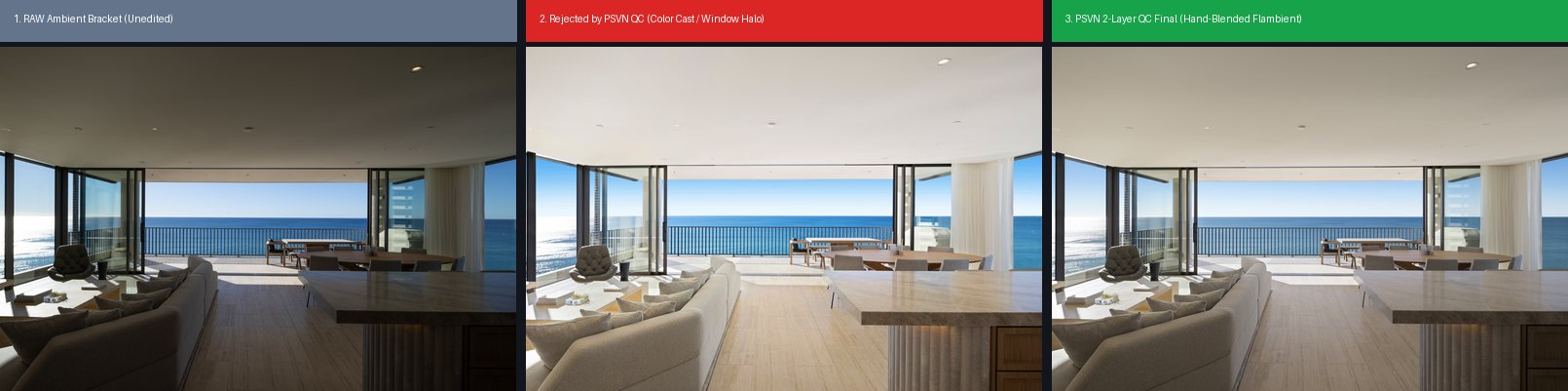
As shown in the production comparison above from our internal QC archives:
1. Panel 1 (Unedited RAW Ambient Bracket): The interior exposure shows warm colour casts on the ceiling and blown-out exterior highlights.
2. Panel 2 (Rejected by PSVN Senior QC Inspector): An initial single-layer edit that left residual warm ceiling tint and uneven window contrast—flagged and rejected internally by our Layer-2 QC team.
3. Panel 3 (PSVN 2-Layer QC Final Delivery): After correction by our Senior QC specialist, ceiling whites are neutral, wood tones are rich and natural, vertical lines are plumb, and the exterior view is balanced without artificial saturation.
On-Site Time vs. Post-Production Cost: Calculating Your Studio’s Hourly ROI (USD, AUD & GBP)
As we detailed in our analysis of the hidden cost of editing everything yourself, spending 2 to 3 hours every evening blending brackets in Lightroom and Photoshop caps your studio’s revenue. Because PSVN charges the exact same per-image rate for multi-bracket HDR and hand-blended Flambient ($0.75–$0.85 USD · A$1.15–A$1.30 AUD · £0.65–£0.70 GBP), your post-production cost for a 35-photo listing is only $26.25 to $29.75 USD (A$40.25–A$45.50 AUD or £22.75–£24.50 GBP).
That means your decision between HDR and Flambient should be driven by your on-site billing model:
– Standard MLS Package (30–35 Photos): Shoot 5-bracket HDR in 30 minutes, upload RAW files to PSVN at 6:00 PM, and deliver hand-blended MLS-ready JPGs to your realtor by 8:00 AM the next morning.
– Luxury & Architectural Package (40–50 Photos + Upsells): Shoot Flambient interiors, add a $3.50–$4.00 Day-to-Dusk virtual twilight hero image, include $10–$12 photorealistic 3D virtual staging for vacant master bedrooms, and bundle a 60–90 second property walkthrough video.
The Hybrid Studio Strategy: Combining HDR Speed with Flambient Precision
You do not have to shoot 100% HDR or 100% Flambient across an entire property. Most high-volume studios in the US, Australia, and the UK that partner with PSVN use a Hybrid Shooting Workflow:
- Main Living Areas, Kitchens & Master Suites (Flambient): Shoot 3 ambient brackets + 1 flash frame + 1 window pull frame in the 8 to 10 hero rooms that sell the home and feature large windows or mixed lighting.
- Secondary Bedrooms, Bathrooms, Laundry & Hallways (HDR): Shoot 3 to 5 ambient brackets without flash in smaller utility spaces where lighting is uniform.
- Exteriors (Ambient Brackets): Shoot 3 ambient brackets for clean sky replacement, lawn enhancement, and driveway shadow recovery.
When you upload a hybrid folder to PSVN, our dedicated editing team automatically blends the flash frames in your hero rooms and hand-blends the ambient brackets in secondary rooms while keeping colour temperature, contrast, and white balance 100% uniform across the entire gallery. That consistency across every delivered listing is what keeps real estate agents booking your studio week after week.
Frequently Asked Questions: HDR vs. Flambient Photo Editing
Does PSVN charge extra for Flambient blending compared to HDR bracketing?
No. Both multi-bracket HDR (3–5 exposures) and hand-blended Flambient (ambient + flash frames) are priced at $0.75–$0.85 USD (A$1.15–A$1.30 AUD · £0.65–£0.70 GBP) per finished photo. Single-exposure editing starts at $0.60 USD (A$0.90 AUD · £0.50 GBP).
How many RAW brackets should I upload per angle for the best results?
For standard HDR, upload 3 to 5 ambient brackets spaced 2 stops apart (-4, -2, 0, +2, +4). For Flambient, upload 1 to 3 ambient brackets plus 1 to 2 flash frames (and 1 darkened window-pull flash frame if the window faces direct sunlight). We accept all native RAW formats including .CR2, .CR3, .NEF, .ARW, .DNG, and .RAF.
Can your editors match my studio’s exact window pull and colour style?
Yes. Every studio account is assigned a dedicated editing team and a custom Style Profile documenting your preferred window pull brightness (natural soft view vs. crisp architectural cut), ceiling white balance (pure white vs. warm ambient), grass tone, and vertical correction standards.
How can I test PSVN’s HDR and Flambient editing quality before switching vendors?
You can start your 100% Free Trial with PSVN today—no credit card required. Send us 3 RAW bracketed photo sets + 1 video clip (or up to 5 RAW bracketed sets), and our team will deliver your finished images within 12–24 hours plus a 10% discount on your first month’s invoice.
Related Articles


Comment